The Kuroshio Limited Express is a JR West service that runs between Kyoto, Osaka and Wakayama Prefecture, and for part of its course it follows the famously scenic route of the Kinokuni Line. In Osaka city you can board this train at Shin-Osaka Station, the underground platforms at Osaka Station, and Tennoji Station. Some Kuroshio services operate to or from Kyoto, but many begin or end at Shin-Osaka Station. Ordinary-car travel on this service is covered by the Japan Rail Pass, but the Kuroshio has all reserved seats, so pass holders should reserve a seat before boarding.
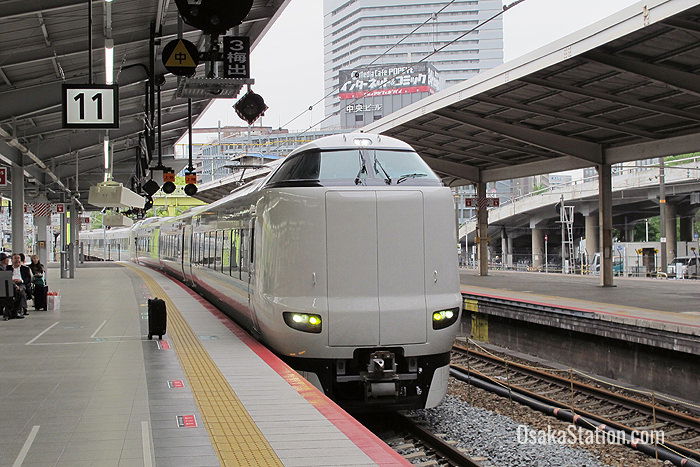
The Limited Express Kuroshio arriving at Shin-Osaka Station
Passengers traveling from Kyoto should check whether a direct Kuroshio service is available, or whether it is more convenient to travel to Shin-Osaka Station first and transfer there. The JR West Route Maps and Timetables page can help you find the most suitable service. Some Kuroshio trains also stop at Hineno Station in Osaka Prefecture, which can be useful for transfers toward the Kansai Airport area.
At Shin-Osaka Station, current timetable data shows Kuroshio Limited Express departures from platform 2. At Osaka Station they use the underground platforms, and at Tennoji Station they usually use platform 15. Always check departure boards at the station, as platforms can change.
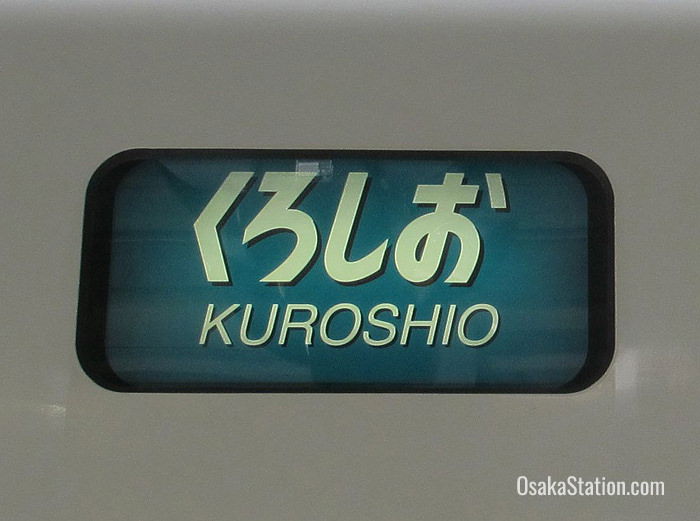
The carriage flag for the Limited Express Kuroshio
Key Destinations
Beyond Wakayama Station the Limited Express Kuroshio runs along the Kinokuni Line. This line follows the coastline of the Kii Peninsula. Beyond Wakayama Station the route is very beautiful as the train runs between the mountains and the sea. When traveling south from Osaka toward Shirahama and Shingu, seats on the right side of the train are recommended for the best views of the ocean. The train fares given below are normal-season adult one-way ordinary reserved-seat fares from Shin-Osaka Station. Limited express fares can vary by season. Train times also vary according to the service, but approximate train times from Shin-Osaka Station are given below.
Wakayama Station
Wakayama city’s biggest tourist attraction is Wakayama Castle. First built in 1585, the current castle keep is a 1958 reconstruction, as the bulk of the castle was destroyed in the last world war. The Kuroshio Market in Wakayama Marina City is another popular attraction. Here you can buy fresh seafood, watch a whole tuna being filleted, or eat in one of many seafood restaurants.
Train fare: around 3,030 yen
Train time: about 1 hour to 1 hour 10 minutes
Kii-Tanabe Station
Tanabe city is a key gateway to the ancient pilgrimage route known as the Kumano Kodo. Kumano Hongu Taisha Shrine is in the wider Tanabe and Hongu area, and it is one of the Three Grand Shrines of Kumano as well as being part of a UNESCO World Heritage Site. The wider Tanabe and Hongu area also has many hot spring baths, some of them in the open air by the Kumano River. Kii-Tanabe Station is also within walking distance of Ogigahama Beach, a popular recreation spot. Tanabe is the birthplace of Morihei Ueshiba, the founder of Aikido.
Train fare: around 5,810 yen
Train time: about 2 hours 20-30 minutes
Shirahama Station
Shirahama is best known as a hot spring resort town. Many hot spring baths are located in the open air overlooking the sea. Shirahama is also famous for Shirarahama Beach, whose white sand has been imported from Australia.
Train fare: around 6,140 yen
Train time: about 2 hours 30-40 minutes
Shingu Station
Shingu’s main tourist attraction is Kumano Hayatama Taisha Grand Shrine, another of the Three Grand Shrines of Kumano and a UNESCO World Heritage Site. Kamikura-jinja Shrine on Mount Kamikura is also a World Heritage-related site, and its sacred Gotobiki-iwa rock commands a spectacular view over the city and the sea. Shingu also has Aikido associations through the Aikido Kumano Juku Dojo.
Train fare: around 7,790 yen
Train time: about 4 hours 15-35 minutes
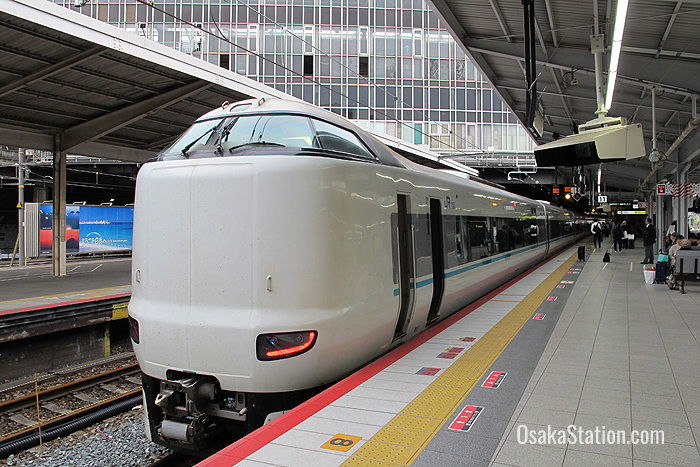
The Limited Express Kuroshio at Shin-Osaka Station
Timetable and Useful Information
Kuroshio trains run through the day from Shin-Osaka Station, Osaka Station’s underground platforms, and Tennoji Station toward Wakayama Prefecture. Not all Kuroshio trains go as far as Shingu Station, and many services terminate before Shingu. Before traveling, check the current timetable and final destination for your train on the JR West Route Maps and Timetables page.
All Kuroshio seats are reserved. If you are using a Japan Rail Pass, make a seat reservation before boarding. Ordinary Japan Rail Pass holders can use ordinary reserved seats on the Kuroshio, while Green Car seats require a Green Car Japan Rail Pass or the appropriate additional charges.
Article and original photos by Michael Lambe. All rights reserved. Last updated 31-Jul-2026.