The JR Takarazuka Line is the name used in passenger guidance for the route between Osaka Station and Sasayamaguchi Station in Hyogo Prefecture. Strictly speaking, this route uses parts of two other lines: the Tokaido Main Line between Osaka Station and Amagasaki Station in Hyogo Prefecture, and the JR Fukuchiyama Line from Amagasaki Station via Sasayamaguchi Station to Fukuchiyama Station in northern Kyoto Prefecture.
On this route, the main destination of interest for visitors is the hot spring town of Takarazuka. The route can also be used to explore the rural Tamba region of Hyogo Prefecture, including pottery country around Aino and the castle town of Tamba-Sasayama via Sasayamaguchi.

A Rapid train for Takarazuka
Key Destinations
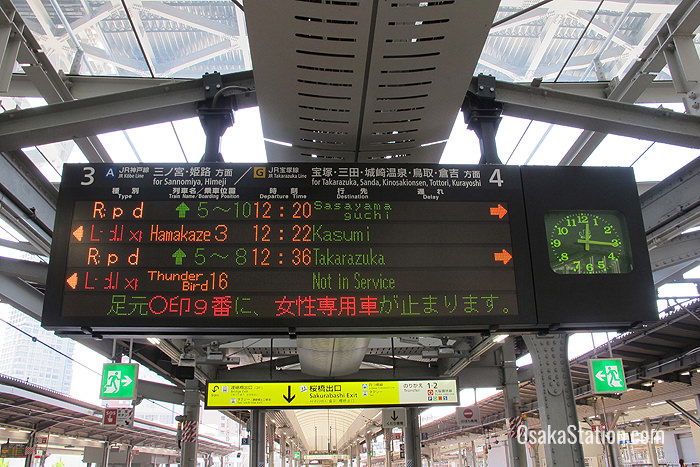
Be sure to check your final destination before boarding
Takarazuka Station
Takarazuka is most famous as the home of the Takarazuka Revue, an all-female musical theater group whose main theater is about 10 minutes on foot from Takarazuka Station. The town’s other attractions include its hot springs, the Osamu Tezuka Manga Museum, and the Tessai Museum, which holds about 1,200 artworks by the renowned literati painter Tomioka Tessai.
Aino Station
Aino Station is in the heart of the rural Tamba region, which is famous for its pottery, or Tamba-yaki. Exit here to visit scenic Tachikui Sue-no-Sato, also known as Tamba Pottery Village, or the Museum of Ceramic Art, Hyogo. From Aino Station, take a Shinki Green Bus bound for Shimizu or Hyogo Togei Bijutsukan. For Tachikui Sue-no-Sato, get off at Sue-no-Sato-mae, or get off at Tachikui-kokaido-mae and walk about 5 minutes. For the museum, get off at Museum of Ceramic Art.
Sasayamaguchi Station
This station is the northern terminus of the JR Takarazuka Line guidance area. Sasayamaguchi is the rail gateway to Tamba-Sasayama, a historical castle town centered on Sasayama Castle. The castle’s Oshoin building was reconstructed in 2000, and the town has museums, galleries, preserved samurai residences, and traditional merchant streets.
Kaibara Station
Kaibara is a scenic market town in Tamba City, known for its wild game cuisine and several buildings of historical interest. Kaibara Hachimangu Shrine is a long-established shrine in the Tamba region and is notable for having a three-storied Buddhist pagoda within its grounds. Another local site of interest is Kinonebashi Bridge, also called Kinone Bridge, which was formed by the roots of a zelkova tree that naturally grew across the river.
Fukuchiyama Station
Fukuchiyama is the northern terminus of the JR Fukuchiyama Line. Fukuchiyama City is best known for Fukuchiyama Castle, which is associated with the warlord Akechi Mitsuhide, who built or rebuilt the castle around 1579 or 1580. The current castle keep was reconstructed in 1986 and contains the Fukuchiyama City Folk Museum. The Jokamachi area beneath the castle also preserves some of the atmosphere of the old castle town.

This local train stops at every station until Shin-Sanda Station
Useful Information
There are 32 stations on the Osaka to Fukuchiyama route. The line is served by Local, Rapid, Regional Rapid, and Tambaji Rapid services, and by the limited express Kounotori for Fukuchiyama and destinations beyond. Local trains stop at every station. Rapid, Regional Rapid, and Tambaji Rapid services skip some stops and may terminate at Takarazuka, Shin-Sanda, Sasayamaguchi, or Fukuchiyama, so be sure to check the final destination before boarding.
For longer trips, the limited express Kounotori is usually faster than ordinary services, but it requires the appropriate limited express ticket or pass and seat-reservation arrangements. You can download a bilingual PDF of the JR guide to stops, on which the stops for each train type are clearly shown. On JR West route maps, the Takarazuka/Fukuchiyama route is colored yellow. Use the JR West Route Maps and Timetables page to plan your journey.
JR trains on this route are covered by the Japan Rail Pass. Local, Rapid, Regional Rapid, and Tambaji Rapid services are ordinary JR trains. For the limited express Kounotori, Japan Rail Pass holders should use the appropriate reserved-seat or limited express arrangements. Non-JR buses and side trips, including buses from Aino Station to pottery sites, are separate.

A Tambaji Rapid service bound for Sasayamaguchi
Article and original photos by Michael Lambe. All rights reserved. Last updated 04-Aug-2026.